
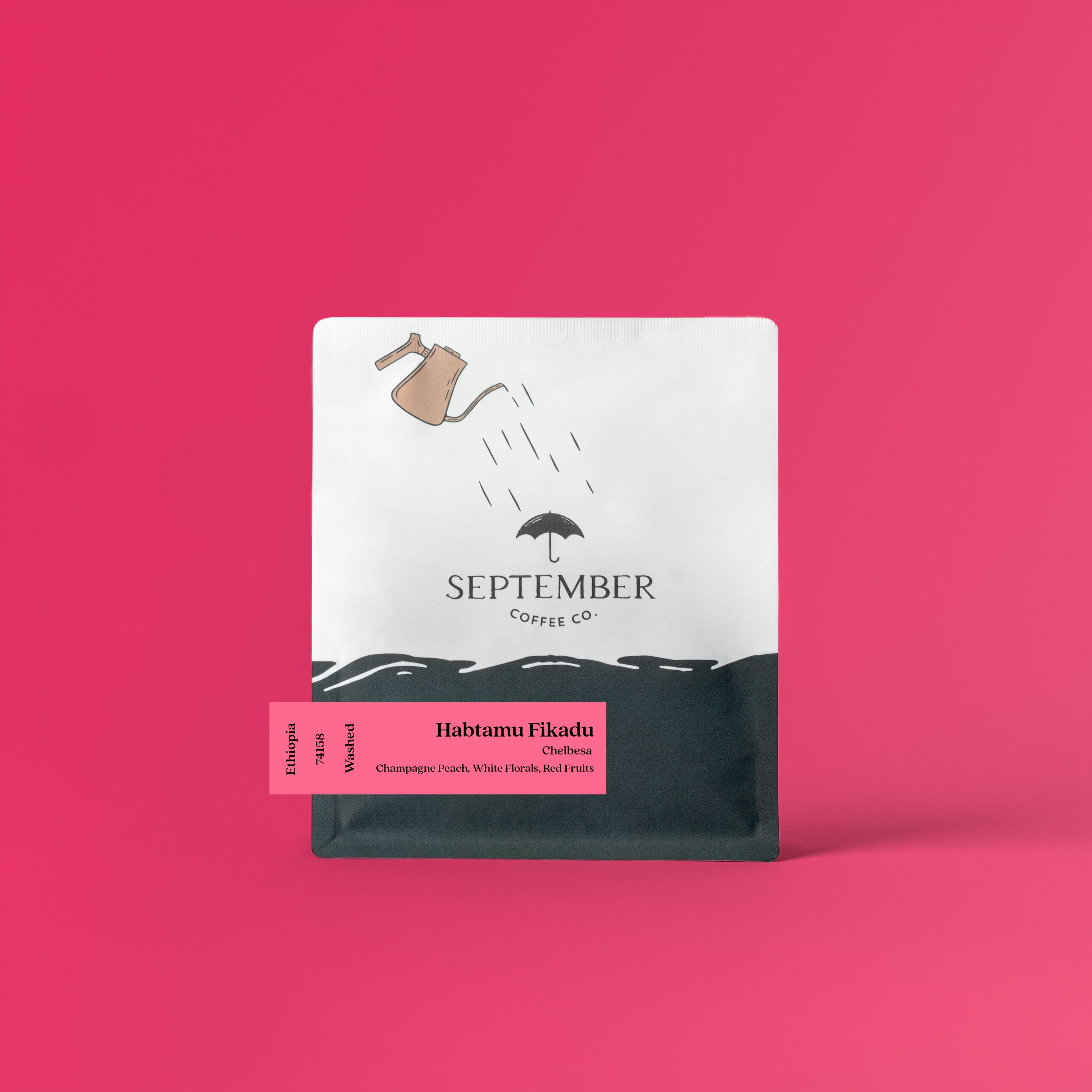


Habtamu Fikadu - Chelbesa (extra-light)
This is our third year working with Habtamu Fikadu and his coffees from Chelbesa. This coffee is sparkling and floral that we best describe as white champagne peaches, white florals and lime. This is an extra-light roast varient of Habtamu's Chelbesa lot. Extra-lights are roast profiles that emphasize clarity over acidity or sweetness, and require additional rest time.
250g
Habtamu Fikadu - Chelbesa (extra-light)
September Coffee Roastery
154 Iber Rd
Unit 9
Stittsville ON K2S 1E9
Canada
- Variety: 74110, 71458
- Country: Ethiopia
- Region: Guji
- Process: Washed
- Altitude: 2000 MASL
- Harvest: 25/26
- Producer: Habtamu Fikadu
- Roast Level: Extra-light
 In the cup
We taste stonefruits, reminding us of white champagne peaches. This coffee has a white florality and juicy red fruit sweetness like apple and pomegranate. It has a light body and a sparkling finish.
 Funky
Funky
 Experimental
 About The Producer
Habtamu Fikadu Aga is the general manager of Kuri Mountain Coffee, an exporting company in Ethiopia. He works alongside Aaga Dinsa to oversee the production of landrace varietals, such as 74110 and 74112. This specific washed lot comes from 140 smallholders in the Chelbesa washing station area.
 Processing
At the company’s washing stations, cherries are pulped and undergo a submerged fermentation lasting 48–72 hours depending on temperature. After washing, the parchment rests in water for another 12 hours before being dried on raised beds for 10–12 days. This careful and consistent method underpins the quality across all of Habtamu’s lots.
 Variety
74110 is a locally selected subvariety of Ethiopian Heirloom, developed in the 70s at the Jimma Agricultural Research Center (JARC) for resistance to the coffee berry disease. The prefix ‘74’ indicates that the selection and cataloguing occurred in 1974. The subvariety 74110 was selected from an original “mother tree” in the Bishari village in the Oromia region. The trees are short and compact, with small leaves and cherries. 74112 is a varietal from the Metu Bishari selections made in the forests of the Illubabor Zone in western Ethiopia in 1974. The Jimma Agricultural Research Center (JARC) selected it (alongside a few others)for its resistance to coffee berry disease.
 Transparency
 Imported
 We Paid
 Roasted Costs